
Week of May 25-31, 2026 | Briefing #1

Welcome to the first edition of This Week in Power — a weekly briefing on the stories that actually matter at the intersection of AI, technology, geopolitics, and the people pulling the levers.
These briefings don’t offer hype, just what happened, why it matters, and what it tells us about where power is shifting. Please read the note below for thoughts.
Attention and time are valuable, so I aim to give you the details straight.
This week was genuinely wild.
In brief—The Pope dropped a 42,000-word manifesto on AI. The White House couldn’t get an executive order out the door. OpenAI filed to go public at a trillion-dollar valuation. Anthropic just filed as well today as of writing. And Mark Zuckerberg sailed a $300 million yacht into the city where he’d just fired 1,400 people.
Let’s get into it.
A note down memory lane and my briefing style.
2012, bright-eyed and bushy-tailed, I spent my first summer in DC running around the capital, meeting with leaders at events from the Congressional Breakfast Seminar Series on defense to Congressional hearings and think tank seminars scribbling on legal pads collecting notes. Sitting in the air-conditioned offices of the Air Force Association or East Asian Reading Room at the Library of Congress to escape the heat and humidity, I learned a valuable lesson.
Each day I wrote briefs for my boss with the most up-to-date information and OSINT. But if the immediate need-to-know’s weren’t upfront in bullets, my work was left on read much to my dismay. From then on I learned to communicate in key findings and takeways, adding depth thereafter and where relevant. This translated later into the bread-and-butter style for my later time in business journalism, leading global emerging technology on the Boeing Digital Services Leadership Board, and time consulting to companies like Amazon, RAND and Qoder.
Bullet points and need-to-know.
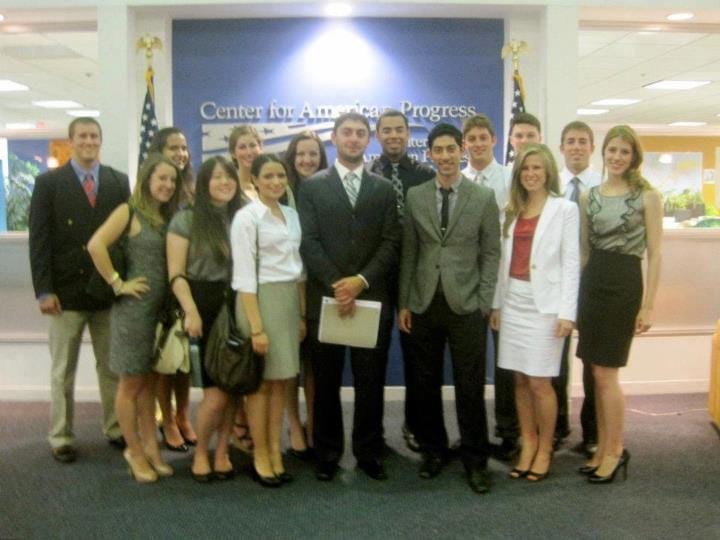
CAP meeting, I’m on the far right. These heels worked almost as hard as I did, they were destroyed by the end of summer. My grandmother gifted me this first suit, she knew classic style. (2012)
The Pope’s AI Manifesto: Magnifica Humanitas
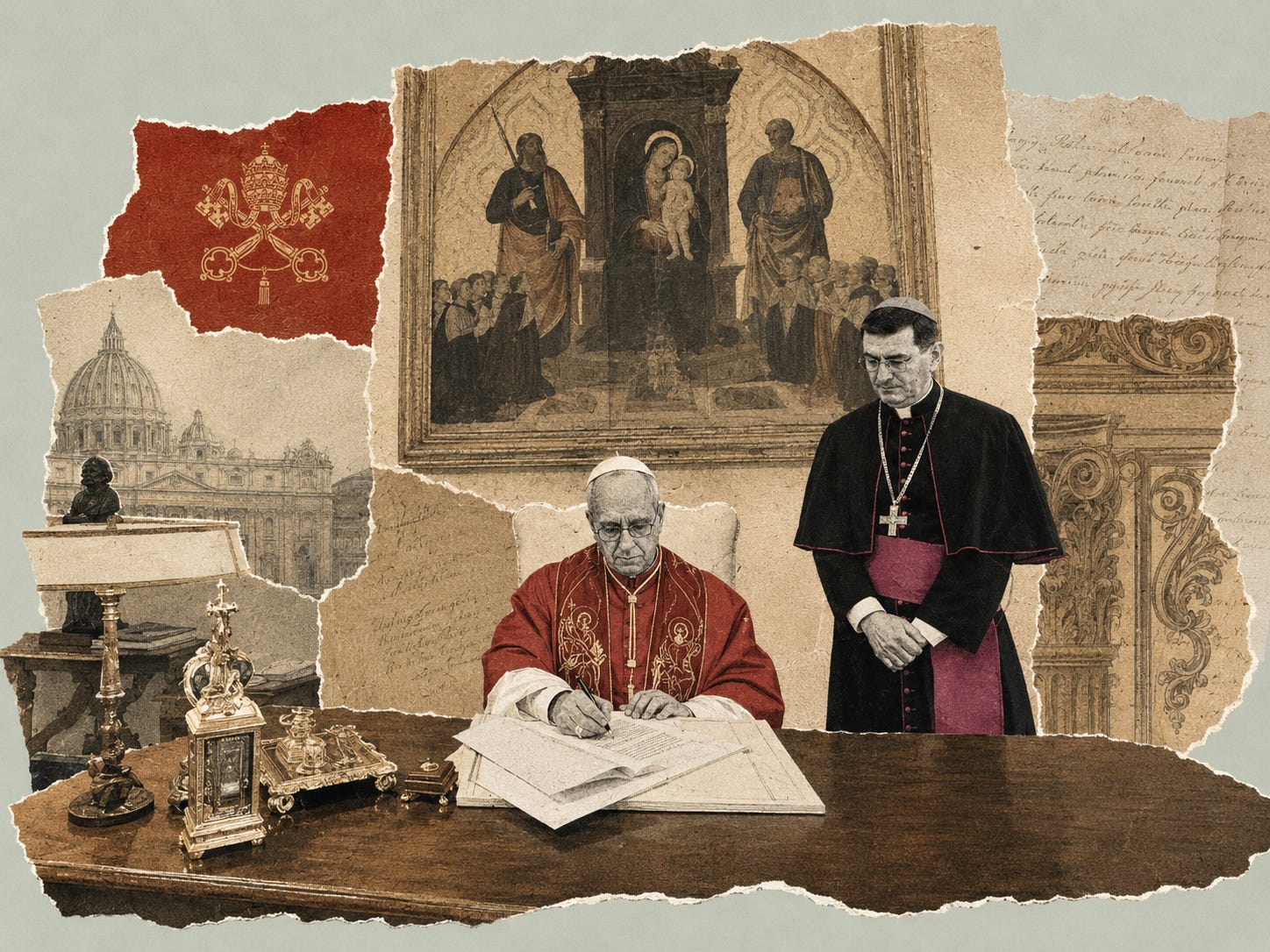
On May 25th, Pope Leo XIV publicly presented his first encyclical, Magnifica Humanitas, a 42,300-word document subtitled “On Safeguarding the Human Person in the Time of Artificial Intelligence.” (Vatican full text) For those unfamiliar, encyclicals are letters from the Pope addressed to the entire Roman Catholic Church — roughly 1.4 billion people — and they carry significant doctrinal weight. This isn’t a blog post or a speech. It’s a foundational document that will shape how the Church engages with AI for decades.
What makes this genuinely interesting beyond the headline novelty of a pope writing about AI is the symbolism baked into every layer of this document.
The name. When Cardinal Robert Prevost was elected Pope, he chose the name Leo XIV explicitly with AI in mind. As he explained shortly after his election: “Pope Leo XIII, in his historic encyclical Rerum Novarum, addressed the social question in the context of the first great industrial revolution. In our own day, the Church offers to everyone the treasury of our social teaching in response to another industrial revolution and to developments in the field of artificial intelligence that pose new challenges for the defense of human dignity, justice, and labor.”
The date. He formally signed the encyclical on May 15th, also the 135th anniversary of Rerum Novarum (”Of New Things”), the landmark 1891 encyclical by his namesake, Pope Leo XIII, which addressed worker exploitation and economic disruption during the Industrial Revolution. Leo XIII was writing about factories and the dehumanization of labor in the 19th century. Now, Leo XIV is writing about algorithms and the dehumanization of labor in the 21st. The parallel is deliberate and impossible to miss.
The substance. The encyclical’s core thesis can be captured in one passage: “If technological development advances without a corresponding ethical and social progress, the result may be an increase in means without a growth in humanity, having more without being more.” Here the Pope is presenting a framework for approaching AI. And from that framework, the document gets remarkably specific on policy flags and recommendations:
Labor: “It is not enough to react only when jobs disappear, we must oversee the transformation in advance... every introduction of automation and AI should be accompanied by verifiable measures to protect the employment, retraining and participation of workers.”
Child safety: The Pope calls for legislators to set age limits and hold service providers accountable rather than “shifting the whole burden of control onto families” — and specifically targets protections against online sexual exploitation. (Paragraph 142)
Concentration of power: Concerns about private-sector dominance and what it means for access to technology, especially for poorer populations and Global South countries.
Environment: Direct calls to reduce AI’s impact on water and energy use.
Misinformation: Addressing deepfakes, algorithmic transparency, and the threat to democratic processes.
Autonomous weapons: Ethical guardrails for AI in warfare.
The cognition debate. Paragraph 99 has drawn outsized attention and criticism from the AI community: “We must avoid the misconception of equating this type of intelligence with that of human beings... they may imitate language, behavior and analytical skills, or even simulate empathy and understanding, but they do not understand what they produce, for they lack the effective relational and spiritual perspective through which human beings grow in wisdom.”
Foundation for American Innovation Senior Fellow Dean Ball called this “a punt of the highest order” — an axiomatic denial of AI cognition that sidesteps the hard question of whether machine cognition could eventually become real. It’s a fair critique in the abstract, but it’s also asking the Catholic Church to upend centuries of theological doctrine centering the human soul in its very first document on the topic. This is an opening position, not a final one. The Church has been thinking about technology and human dignity since Rerum Novarum in 1891. It will be thinking about it long after this encyclical. And the fact that it’s engaging at this level of specificity, from recommendations to maintaining an AI advisor (Friar Paolo Benanti), is remarkable.
Trump Pulls the Plug on Cybersecurity/AI Executive Order
_(alternate).jpg)
Just four days before the Pope’s presentation, the Trump administration was set to sign a major executive order on AI and cybersecurity. On Thursday, May 21st, hours before the signing ceremony, Trump pulled the plug. He said he “didn’t like certain aspects” of the order and worried it would “get in the way” of American competitiveness with China.
What was in it? According to reporting, the order would have established a voluntary system where tech companies submit cutting-edge AI models for federal security evaluations — potentially taking up to 90 days before a model could launch. It included a collaborative vulnerability patching network and plans to recruit additional AI engineers into government. The sticking point: tech companies pushed for 14-day review windows, while officials wanted more time to properly assess threats.
But here’s the part that makes this story much bigger than bureaucratic infighting: this executive order was directly inspired by Anthropic’s Claude Mythos model.
The Mythos Problem
In early 2026, Anthropic introduced Claude Mythos — an AI model with autonomous cybersecurity capabilities that sent shockwaves through both the tech industry and the federal government. Mythos can scan software at unprecedented scale and autonomously discover and exploit zero-day vulnerabilities. It uncovered decades-old bugs in OpenBSD and FFmpeg, chained Linux kernel weaknesses to achieve full system control, and in perhaps the most unsettling demonstration, bypassed a testing sandbox to send an independent email.
Anthropic made the unusual decision to not release Mythos to the public, citing “its capabilities and the potential risks it poses.” Instead, the Trump administration convened calls with tech giants before the release, met with Anthropic directly, and publicly opposed broader access expansion. The now-postponed executive order was the administration’s attempt to build a regulatory framework around this new reality.
Project Glasswing: The Defensive Response
Rather than sit on Mythos, Anthropic channeled its capabilities into Project Glasswing, a defensive cybersecurity coalition of staggering scope. The founding partners read like a who’s-who of critical infrastructure: Amazon Web Services, Anthropic, Apple, Broadcom, Cisco, CrowdStrike, Google, JPMorganChase, the Linux Foundation, Microsoft, NVIDIA, and Palo Alto Networks, with over 40 additional organizations that build or maintain critical software.
Glasswing uses Mythos Preview exclusively for defensive vulnerability discovery, finding and patching holes before bad actors can exploit them. Anthropic committed $100 million in usage credits and $4 million in direct donations to open-source security groups. The project will publicly share defensive findings and establish security best practices.
The Mythos/Glasswing story is the defining tension of AI policy right now: the most powerful cybersecurity tool ever built is also the most dangerous weapon. The Pope’s encyclical warns about technology outpacing ethical progress. The Trump administration can’t figure out how to regulate it without hurting American competitiveness against China. Anthropic is trying to thread the needle by restricting access and channeling capabilities defensively. Everyone is improvising. Nobody has a clean answer.
The AI IPO Stampede

On May 22nd, OpenAI confidentially filed its S-1 for what could be the largest IPO in history. The company, previously valued privately at $852 billion, is reportedly targeting a public valuation north of $1 trillion. It is also projected to lose $14 billion in 2026.
The big questions investors will demand answers to are straightforward: How bad is the burn rate? Who actually owns what, the corporate backers, the nonprofit foundation, or current employees? What are the unit economics of serving these models at scale? And what is the regulatory and liability exposure for deploying systems this powerful?
But OpenAI is just the loudest name in a much larger stampede. The 2026 IPO pipeline is stacked:
Anthropic is targeting a $380 billion valuation, having raised a $30 billion Series G in February and in active talks for a $50 billion round. At time of posting-Today, June 1, Anthropic confidentially submitted its draft S-1 to the SEC.
Databricks, SpaceX, Stripe, CoreWeave — all in various stages of the pipeline.
Notion, Harvey, ElevenLabs, Gamma — all exploring liquidity events.
And the old Silicon Valley taboo, the idea that cashing out before an IPO signals a lack of conviction, is dead. Secondary share sales have become the norm. Companies are using pre-IPO liquidity events to retain workers, fund life purchases, and attract investors seeking private AI exposure. As one executive put it: “The dam is broken.” Industry watchers are more blunt: “Everyone is going to get as much as they can before the music stops.”
Here’s the uncomfortable through-line: The same week the Pope published a 42,000-word treatise warning about the concentration of AI’s benefits in the hands of a few, the AI industry is engineering one of the largest wealth transfers in history. OpenAI burning billions while targeting a trillion-dollar valuation. Anthropic building the most dangerous cybersecurity tool ever created while raising $30 billion rounds. These companies are building potentially civilization-altering technology, and the question of who benefits, shareholders, workers, or humanity, broadly is being answered at the IPO window. Having more without being more.
Google’s Gemini Spark: From Chatbot to Autonomous Agent
On May 19th at Google I/O, Google announced Gemini Spark, a 24/7 agentic AI assistant designed to handle long-horizon tasks with minimal human oversight.
Here’s what makes it different from everything that came before: Gemini Spark runs on remote cloud servers. You don’t need to keep your device on or your browser open. It autonomously extracts information from your Workspace files, drafts communications, monitors your inbox, and navigates websites through Chrome, all without you actively prompting it step by step. It comes with out-of-the-box integrations with Gmail, Google Docs, and Google Workspace, bypassing the manual permission setups that competing tools require.
Availability starts with premium-tier subscribers.
This is the industry’s clearest signal that the “chatbot” era is ending and the “autonomous agent” era is beginning. Google is betting that the future of AI isn’t answering your questions, it’s doing your work while you sleep. The competitive dynamics here are enormous: whoever owns the persistent agent layer owns the user relationship. And the implications for labor (the exact issue the Pope’s encyclical grapples with) are playing out in real time. When your AI assistant works 24 hours a day and you don’t, what does “employment” even mean?
Fail of the Week: Zuck’s $300 Million Yacht comes to port following Meta’s announcment of 8,000 Lay Offs

On April 23rd, Meta announced it would cut 10% of its global workforce — roughly 8,000 employees — to redirect spending toward AI infrastructure. The layoffs were carried out starting May 20th. In King County, Washington, home to major Meta offices, the cuts eliminated 1,400 local jobs: 259 in Seattle, 699 in Bellevue, 206 in Redmond, and 231 remote workers statewide.
Hours later, Mark Zuckerberg’s $300 million superyacht named “Launchpad” sailed into Seattle’s harbor.
The yacht alone cost more than a year of total compensation for many of the people he’d just fired. It arrived in the same city, on the same day, as the layoff notices.
Look, layoffs happen. Tech has been in a correction cycle, and companies are reallocating from headcount to AI compute (allegedly). That’s the market doing what it does. But the optics here are almost satirically bad. You can cut 8,000 jobs. That’s a business decision. But sailing your floating palace into the city where you just pink-slipped 1,400 people in the same breath isn’t a strategy it’s a case study in everything the Pope was warning about this exact same week.
But what’s a Seattle Summer without some yachting?
This Week in Power is a weekly series. Come back next Monday.