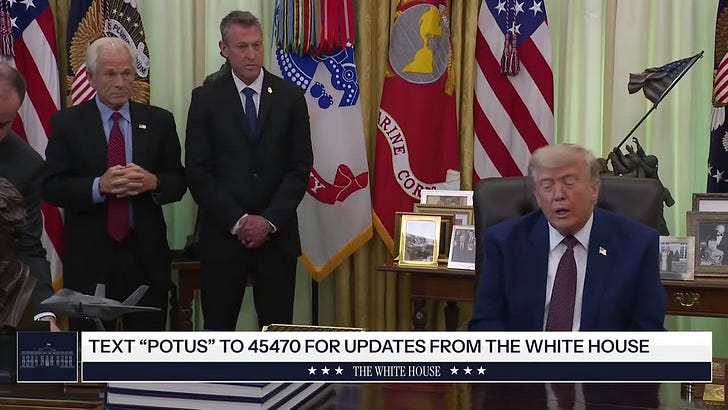

US President Trump flew the richest delegation in history to meet Chinese Leader Xi Jinping. Here’s what the US–China summit’s CEO diplomacy moment, a garden walk, and a chip standoff means for tech, trade, and the new global playbook.
This Summit brings us into a dynamic where we are looking at US-China affairs through more of a business, transactional engagements. People calling it a snooze fest and old men just doing things, miss the larger picture and evolving undercurrent.
“In the realm of AI, we can also see introduction of talks on US-China cooperation on AI and what that could look like… This opens up a window for perhaps flexibility in the types of deals that we could see coming out to industry, policy, and business moving forward. Something to reimagine and not what we’ve traditionally seen.”
Host: Chelsea Toczauer
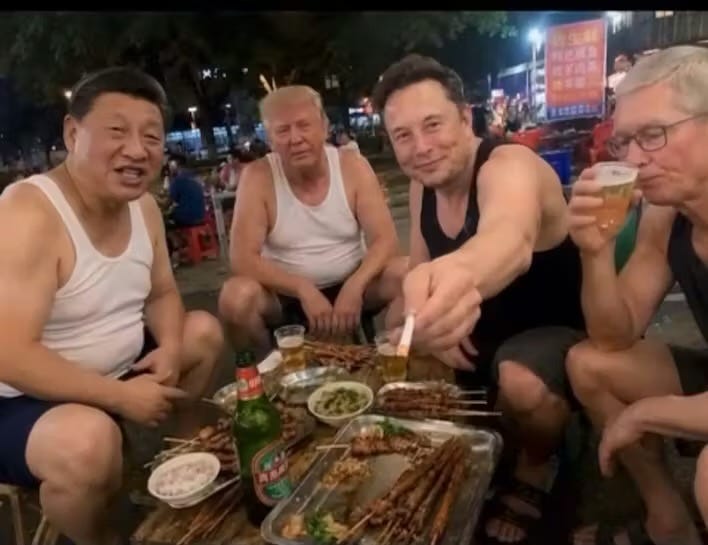
Above: AI-generated image inspired by US-China leaders meeting over chuan’er and drinks.
Context
Summit nearly canceled due to US–Iran tensions and uncertainty around Trump’s participation and delegation composition
Three figures driving US China policy right now: Trump, Treasury Secretary Scott Bessent, and Secretary of State Marco Rubio
Notable Chinese flexibility: Rubio (under Chinese sanctions) and Jensen Huang (last-minute Alaska refueling arrival) were both included
Largest net-worth business delegation in US history; first inclusion of the US defense industry in a bilateral summit since Nixon
Delegation included Jensen Huang (NVIDIA), Elon Musk, Apple, BlackRock, Boeing, and financial services and defense representatives
Tone & the new dynamic
Relationship shifting from adversarial to transactional — “interconnected competition” replacing open hostility
Current de-escalation driven partly by the US being preoccupied with Iran and other global activities
Trump was flattering and effusive; Xi was measured, restrained, and polite — a deliberate contrast
Xi granted Trump rare access to the Zhongnanhai residence gardens; Putin is the only other leader mentioned as having visited
Overall framing from both sides: move from adversarial enemies toward strategic, commercially-minded partners
Chinese netizens noted: if this is now a transactional relationship, and that the delegates were the agenda
Key geopolitical signals
Taiwan red line: Xi raised Taiwan early — framing it as personal legacy and an internal Chinese matter. Trump did not respond directly, leaving deliberate ambiguity
Thucydides Trap: Xi invoked the concept of a rising power inevitably clashing with an incumbent one, implicitly positioning China as the rising global leader. Notably this framing also appeared in the US–UK relationship, one of the few historical cases where the trap was avoided
Denuclearization: Trump briefly raised this, extending his conversations with Putin; China is unlikely to engage
China positioning itself as a stabilizing global force amid US volatility
Trump responded to Xi’s Thucydides framing on Truth Social after the trip, attributing US decline to the Biden era while presenting his own administration as a reset
Technology & chips
No change on chip export policy: the US approved H200 sales to 10 Chinese tech companies, but China declined — directing domestic companies toward Chinese-made chips instead, notably Huawei
That rejection has not been reversed, meaning the US approval currently means nothing in practice
Jensen Huang running a dual-market PR campaign: “down to earth” in Beijing (noodle photo shoot), thought leader in Washington DC (think tank circuit)
Rare earth and critical minerals not addressed at the summit but expected in future talks
US–China cooperation and governance of AI surfaced as a topic — one to watch closely
Business & industry
Boeing secured a deal
Elon Musk attended with his son; Tesla’s Shanghai Gigafactory remains the only foreign-owned EV plant in China without a joint venture partner
Lei Jun (Xiaomi) photographed taking a selfie with Musk — signals the regard Chinese tech leaders have for him
Chinese EVs: Biden-era 100% tariffs remain in place, but significant US consumer demand exists; Chinese EV design and manufacturing have advanced rapidly and visibly since 2017
No immediate changes to tariffs or market access announced
China’s AI & tech landscape
Significant M&A activity and leadership reshuffling across Chinese AI companies over the past two years
China’s 15th Five Year Plan and new AI governance guidelines published earlier this year signal long-term strategic intent
Data center construction is a key pressure point — China faces fewer political and grid constraints than the US
Unusual logistics note: large semiconductor and compute component orders being routed through Switzerland via Berlin and the UK — origin and destination unclear, worth watching
Looking Ahead
Taiwan: will the US formulate a response to Xi’s red line, and does Trump’s silence signal flexibility?
Critical minerals negotiations in follow-on talks
Whether China alters its stance on H200 chip purchases
Potential new US–China AI governance cooperation
Further reading
The Thucydides Trap
Thucydides Trap Case File — Harvard Belfer Center — the full 16-case database Chelsea references, including Case 11 (US–UK)
Thucydides Trap: Peace & Rivalry Between the US and China — Harvard Kennedy School — Graham Allison’s ongoing research, including Xi’s direct engagement with the concept
China’s 15th Five-Year Plan (2026–2030)
Decoding China’s 15th Five-Year Plan — Foreign Policy Research Institute — sharp analysis of what changed between the October 2025 draft and the final March 2026 version
What the 15th Five-Year Plan Means for Global Investors — Neuberger — investment-lens read with a note that the plan may matter more than the summit itself
China’s AI strategy
Where Does AI Fit in China’s 15th Five-Year Plan? — Geopolitics & AI Substack — co-authored by Chelsea Toczauer; directly referenced in this episode
Jacob Gunter & MERICS: Trade-Offs of Innovating in China — the Jacob Gunter work Chelsea mentions; MERICS is the leading European China research institute
Speq RSS Podcast
Speq Podcast
If you like this podcast, share an idea with a friend and follow for more.
We’re going to have more interviews coming up, looking at power, people, systems, and decisions behind it and how you can apply it for your work and what it means for the world.
Because every innovation every source of power starts from unseen potential. I’m Chelsea Toczauer. Thanks for listening and follow for more.